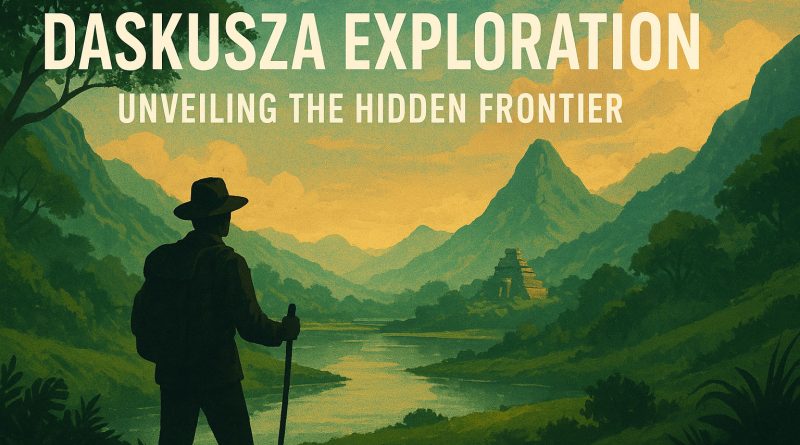
Daskusza Exploration: Unveiling the Hidden Frontier
Introduction
In a world where so much seems discovered, daskusza exploration emerges as a concept that dares to challenge what we know. It blurs the lines between myth and reality, inward journeys and outward discovery. Whether viewed through the lens of ancient folklore, modern science, or personal growth, daskusza beckons us to explore the unknown in all its dimensions.
What is Daskusza Exploration?
“Daskusza” is a term that hasn’t been pinned to any textbook or map, making it mysterious and irresistible. The concept of daskusza exploration refers to investigating places, stories, or states of being that are hidden — deliberately or through neglect. It can mean:
- Searching for lost civilizations or enigmatic ruins.
- Exploring spiritual or psychological frontiers.
- Uncovering hidden truths in culture or nature.
Though its precise origin is ambiguous, many believe “daskusza” has roots in forgotten dialects or oral traditions. It may carry echoes of words meaning “whisper,” “hidden land,” or “lost knowledge.” Its power lies in mystery, inviting explorers to build meaning rather than merely consume facts.
Geographic, Cultural, and Mythical Dimensions
Though no confirmed map shows “Daskusza,” stories from remote regions describe landscapes lush with forest, shrouded valleys, sacred lakes, and ruins swallowed by time. In these tales, daskusza exploration becomes less about coordinates and more about experience.
Modern Tools & Methods of Exploration
With technology we now can explore the hidden in ways ancestors could only imagine. Daskusza exploration today uses:
- Satellite imagery, LiDAR, and drone surveys to penetrate forest canopy and detect hidden structures.
- Archaeological methods to excavate ruins, analyze artifacts, interpret ancient inscriptions.
- Interdisciplinary research combining anthropology, geology, folklore, linguistics, ecology.
These tools are crucial not only to discover but also to verify: what is myth, what is history, what might be the literal truth buried in the stories.
The Inner Frontier: Psychological & Symbolic Daskusza
Not all exploration needs travel or maps. Daskusza exploration has also come to mean internal journeys:
- Self-discovery: examining one’s beliefs, confronting fears, understanding one’s deeper values.
- Symbolic insight: using myths, dreams, and stories to understand what lurks in the subconscious.
- Transformation: allowing exploration (both external and internal) to reshape identity, purpose, vision.
For many, the most profound discoveries are the ones inside — the mind, the heart, the spirit.
Ethical Considerations & Responsible Discovery
Exploring legendary or underserved regions carries responsibility. With daskusza exploration, this means:
- Working with local communities so that their stories are represented authentically.
- Avoiding exploitation: not turning myths or sacred places into mere tourist spectacles.
- Protecting ecology: many of the regions alluded to are fragile. Preserving biodiversity, preventing damage.
- Clearly distinguishing myth from evidence: acknowledging what is belief, what is hypothesis, and what is proven.
Why Daskusza Exploration Matters Now
In the 21st century, the allure of exploring the unknown is more relevant than ever. Here’s why:
- We face environmental crises; learning from traditional ecological knowledge (often part of daskusza legends) might help.
- Mental health and meaning are increasingly sought — inner exploration leads to resilience, perspective, balance.
- Science continues to expand boundaries (quantum physics, deep space, microbiome) — parallel to that, we need humility and imagination.
Daskusza exploration, then, is not just a fanciful term. It’s a call to curiosity — to dig beneath the known, to connect with past and place, to push ourselves beyond comfortable certitudes.
Conclusion
Daskusza exploration stands at the intersection of myth, nature, culture, and inner growth. It reminds us that even in a world mapped and catalogued, there remain territories to explore—within forests, under ice, in folklore, and in our own hearts. Whether you are an adventurer scaling ridges, a scholar reading dusty manuscripts, a dreamer seeking deeper meaning, or someone simply curious — daskusza offers a journey with many paths. The key is openness, respect, and the courage to explore even when the map fades.