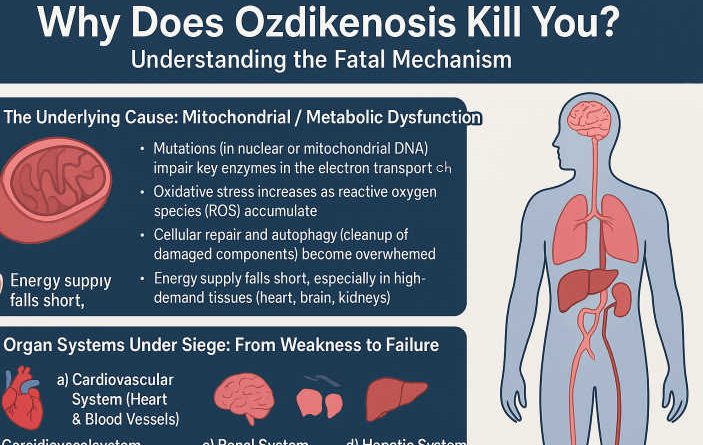
Why Does Ozdikenosis Kill You? Understanding the Fatal Mechanism
Ozdikenosis is hypothesized to be a rare, severe genetic/metabolic disorder that progressively undermines vital body systems. Over time, the accumulation of cellular dysfunction, organ failure, and systemic collapse leads to death. To understand why ozdikenosis is lethal, we must examine its internal damage — from the molecular level to organ failure — and how that cascade becomes irreversible.
1. The Underlying Cause: Mitochondrial / Metabolic Dysfunction
At the core of ozdikenosis is a dysfunction in the cellular energy machinery. Cells depend on mitochondria to convert nutrients (glucose, fats, amino acids) into ATP — the energy “currency” that powers all biological processes. In ozdikenosis:
- Mutations (in nuclear or mitochondrial DNA) impair key enzymes in the electron transport chain.
- Oxidative stress increases as reactive oxygen species (ROS) accumulate.
- Cellular repair and autophagy (cleanup of damaged components) become overwhelmed.
- Energy supply falls short, especially in high-demand tissues (heart, brain, kidneys).
Because most organs rely on continuous energy output, even a modest drop in ATP production can gradually weaken their function. The body attempts to compensate (e.g., by increasing blood flow, shifting metabolism), but the compensatory mechanisms are fragile and foster further damage.
2. Organ Systems Under Siege: From Weakness to Failure
Once mitochondria falter, organs begin to suffer. The failure doesn’t happen all at once, but in stages, and the more organs are affected, the harder it is to sustain life. Below are key systems that typically collapse in such conditions:
a) Cardiovascular System (Heart & Blood Vessels)
The heart is one of the most energy-demanding organs. When mitochondrial output declines:
- Cardiac muscle weakens; contractions become inefficient.
- Arrhythmias (irregular heartbeats) emerge as ion homeostasis falters.
- Reduced ejection fraction leads to poor perfusion of tissues.
- Backflow and congestion may cause fluid buildup in lungs (pulmonary edema) or peripheral tissues (edema).
Ultimately, the heart may fail to pump adequately — if it stops, death follows swiftly.
b) Neurological System (Brain & Nerves)
The brain is extremely susceptible to energy deficits:
- Neurons lose their ability to maintain ion gradients, causing cell stress or death.
- Myelin sheaths (in some diseases) degrade, slowing electrical conduction.
- Seizures, cognitive decline, loss of consciousness may follow.
When widespread neuronal death or dysfunction occurs, essential control of respiration, heartbeat, and consciousness is lost.
c) Renal System (Kidneys)
Kidneys are responsible for waste filtration and maintaining internal chemical balance:
- Damage to kidney tubular cells impairs filtration and reabsorption.
- Electrolyte imbalances (potassium, sodium, calcium) arise.
- Toxins and metabolites accumulate in blood.
- Eventually, acute or chronic renal failure may occur.
When kidneys fail, dialysis is needed; without it, fluid overload, metabolic acidosis, and uremia can become fatal.
d) Hepatic System (Liver)
The liver detoxifies blood, synthesizes proteins (e.g. clotting factors), and regulates metabolism:
- Mitochondrial damage leads to cell death (hepatocytes).
- The liver cannot clear toxins (e.g. ammonia) or produce essential proteins.
- Blood clotting may fail; bleeding becomes a risk.
- Liver failure contributes to multi-organ crisis.
e) Respiratory & Musculoskeletal Systems
- The muscles that power breathing (diaphragm, intercostals) may weaken, reducing respiratory capacity.
- Oxygen delivery to tissues declines.
- Muscle wasting, weakness, fatigue become profound, limiting mobility and increasing risk of complications (pneumonia, bedsores, etc.).
3. The Cascade: Interdependence and Feedback Loops
What often makes diseases like ozdikenosis lethal is not just one organ failing, but the feedback loops and interdependence among organs:
- Cardiac weakness reduces perfusion to kidneys and brain, further impairing their function.
- Renal failure leads to toxin buildup, which weakens heart and liver further.
- Liver failure allows toxins to circulate, damaging brain and other tissues.
- Inflammation (from cell damage) causes further oxidative stress.
- Immune system dysregulation may lead to systemic inflammatory response (sepsis-like syndrome).
As each system degrades, the remaining “reserve capacity” vanishes. Once a tipping point is crossed, the body can no longer restore homeostasis. The final progression is swift — a collapse of multiple vital systems nearly simultaneously.
4. Clinical Progression & Timeline (Hypothetical)
While timelines vary by severity, genetic variant, and external interventions, a general progression might look like:
| Phase | Years / Months | Key Signs | Prognosis |
|---|---|---|---|
| Early | 0–1 | Fatigue, mild weakness, metabolic abnormalities in lab tests | Manageable, slower decline possible |
| Moderate | 1–3 | Organ-specific symptoms: arrhythmias, renal impairment, early neurological issues | Increasing morbidity, hospitalizations |
| Advanced | 3–5 | Multi-organ dysfunction: heart failure, kidney/liver failure, seizures, respiratory compromise | High risk of death without transplantation or advanced therapy |
| Terminal | Final weeks to days | Shock, coma, respiratory arrest, cardiac arrest | Death |
Without advanced treatment, median survival might be only a few years after onset of moderate symptoms.
5. Why Treatment Is Challenging & Lethal Outcome Happens
Even with modern medicine, several obstacles make ozdikenosis nearly fatal:
- Irreversible cell loss: Once organ cells die, they are not easily replaced.
- Complex mutation patterns: Gene therapy may need to correct multiple genes or mitochondrial DNA, which is technically challenging.
- Delivery challenges: Reaching affected tissues (brain, heart, kidneys) with therapeutics is hard.
- Side effects & toxicities of attempted remedies compound stress on already fragile systems.
- Late diagnosis: Often, disease is detected only after symptoms manifest, when much damage is already done.
Given these factors, many patients succumb because there is insufficient time or resilience left for interventions to reverse the downward spiral.
6. Ethical & Supportive Aspects in the Final Phase
In the final days, care shifts toward palliative support:
- Pain management, sedation.
- Respiratory comfort (oxygen, ventilatory support).
- Nutritional and fluid support (or removal if overload).
- Family counseling, psychological and spiritual support.
Even if death cannot be averted, maximizing dignity and minimizing suffering becomes the priority.
Conclusion
In essence, ozdikenosis kills you because it strikes at the fundamental building block of life: energy generation and maintenance of internal order. The failure begins in tiny subcellular structures (mitochondria) but ripples outward, overwhelming organs in cascade until no system can sustain itself. Because the damage is multi-systemic, insidious, and cumulative, by the time symptoms are apparent, the body often cannot recover or compensate.